

Secrets management architecture#
Intended audience
staff members
1. Global Architecture#
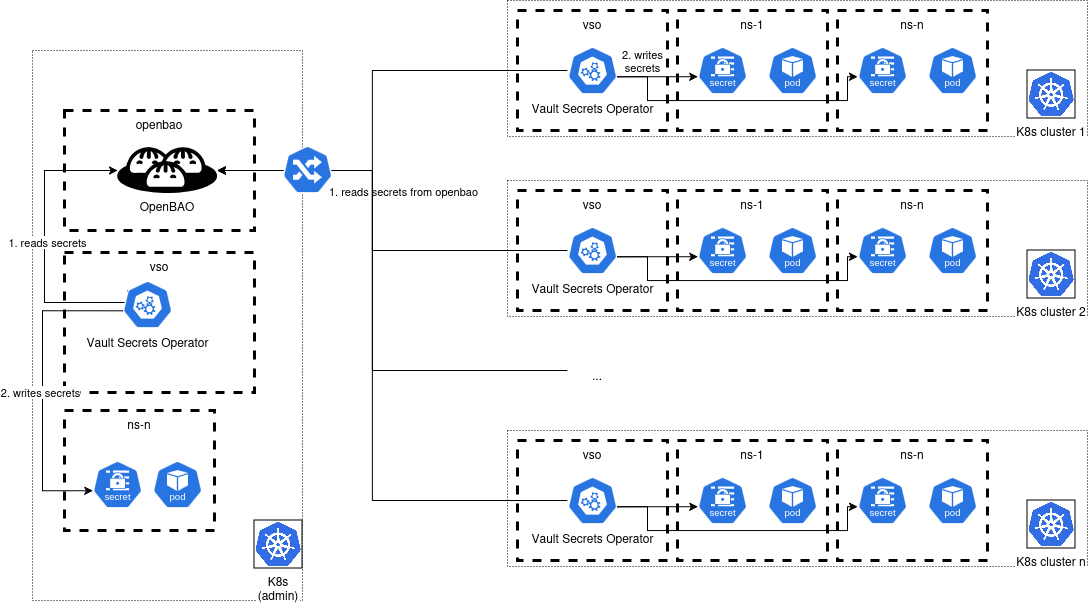
OpenBao is deployed centrally within the administration cluster (k8s-admin), serving as the single source of truth for all infrastructure secrets. This cluster hosts the OpenBao instance alongside the Vault Secrets Operator (VSO), which orchestrates secret synchronization toward remote application clusters.
Each target Kubernetes cluster (K8s cluster 1, 2, n) runs its own
dedicated VSO instance, deployed in a vso namespace. The VSO
connects to OpenBao through an Ingress exposed from the
administration cluster, ensuring secure communication between remote
clusters and the central service.
This follows a hub-and-spoke model:
OpenBao (the hub) distributes secrets.
Each Kubernetes cluster (the spokes) consumes them locally.
Once fetched by the VSO, secrets are automatically injected into native
Kubernetes Secret objects within application namespaces
(ns-1, ns-n, etc.).
Pods in those namespaces consume secrets directly from the local Kubernetes API without ever needing to authenticate against OpenBao.
This architecture provides:
Centralized governance
Local high-performance consumption
Horizontal scalability
Onboarding a new cluster only requires:
Deploying a VSO instance in the target cluster.
Configuring network access to the administration cluster Ingress.
2. Openbao/VSO#
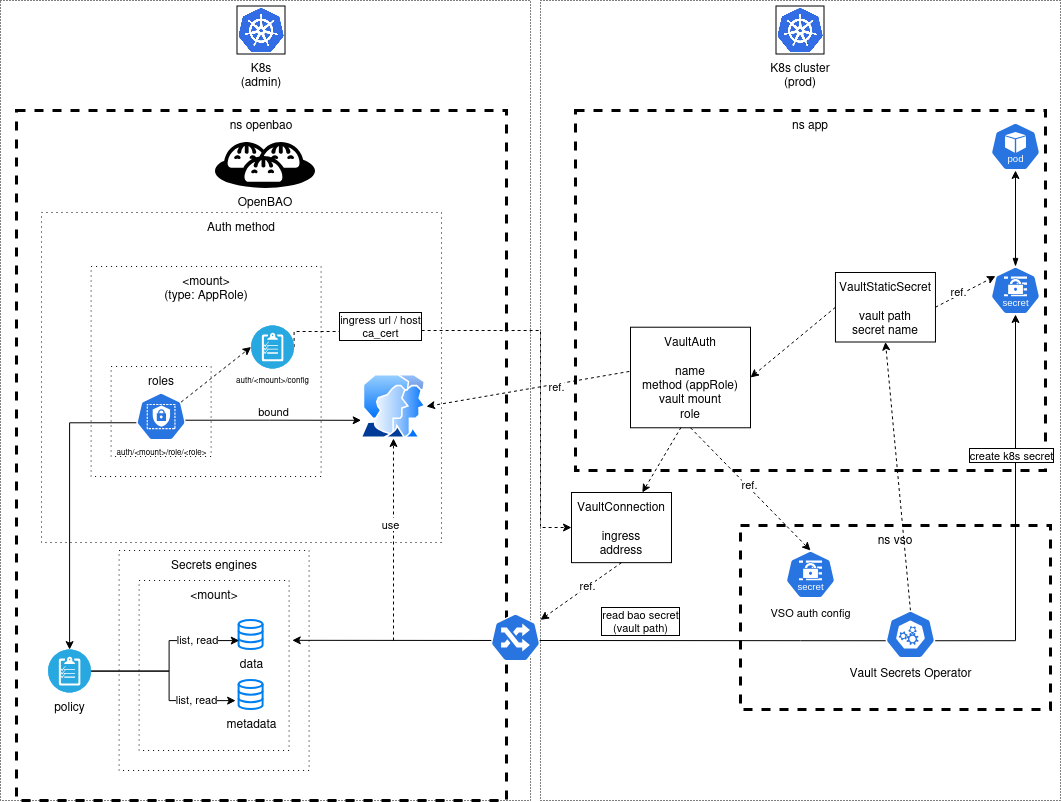
Within the administration cluster (k8s-admin), OpenBao runs in a
dedicated openbao namespace. It is configured with
authentication methods (notably AppRole), roles tied to
fine-grained policies, and one or more secrets engines,
each engine storing its data and metadata in isolation.
An Ingress exposes the OpenBao API externally, acting as the single entry point for all consumer clusters.
The vso namespace hosts the Vault Secrets Operator (VSO),
the sole component authorized to communicate with OpenBao.
The app namespace contains declarative resources and application
workloads. Three Custom Resource (CR) objects are defined there:
VaultConnection: specifies the Ingress URL and TLS certificates required to reach OpenBao.VaultAuth: references the AppRole authentication method and the credentials stored in a Kubernetes secret.VaultStaticSecret: designates the exact secret path to synchronize within OpenBao and the authentication policy to use.
The operational flow is fully automated by the VSO.
The operator continuously watches VaultStaticSecret objects in the
app namespace. Upon detection, it uses VaultAuth to
authenticate against OpenBao via AppRole (which uses the
VaultConnection to connect to openbao).
It then queries the secrets engine at the path specified in
VaultStaticSecret. Once the data is retrieved, the VSO creates or
updates a native Kubernetes Secret in the app namespace.
The application pod consumes this secret locally (through environment variables or mounted volumes), without ever needing to know about OpenBao or authenticate against it.
This architecture strictly decouples:
Centralized secret governance in the administration cluster.
Local and secure secret consumption in production clusters.
It also ensures automatic renewal through the VSO reconciliation loop.
3. Deployment#
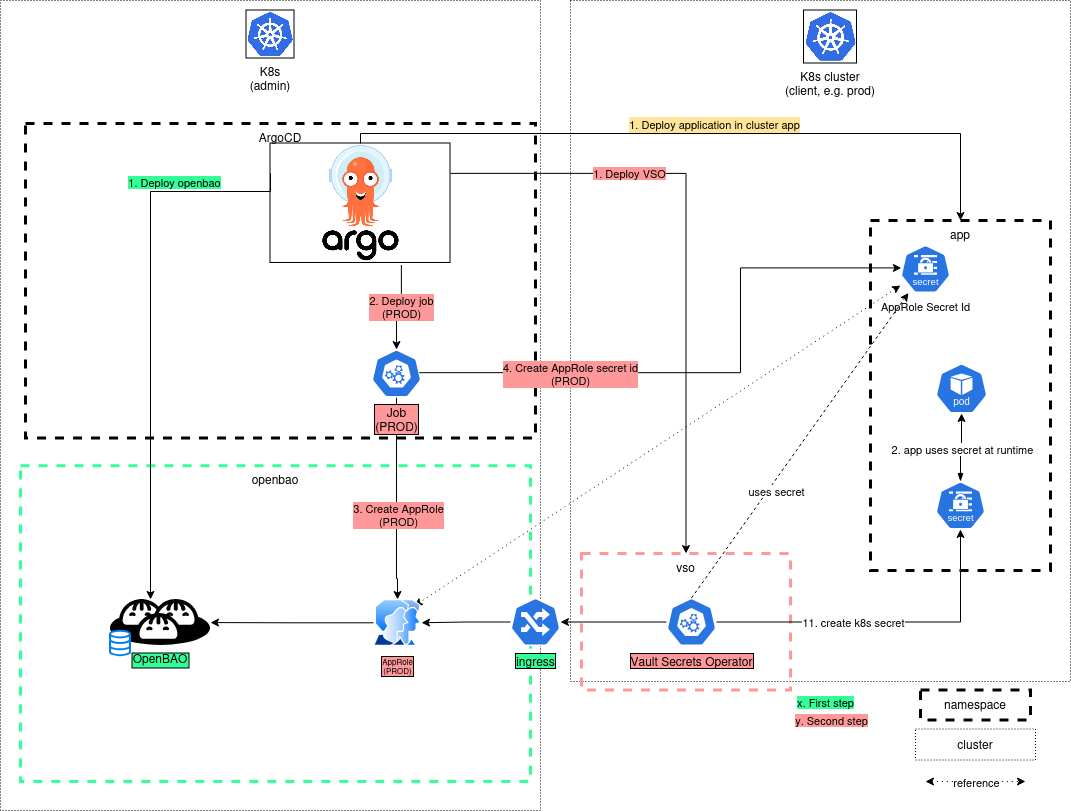
Secret deployment is orchestrated end-to-end by ArgoCD, ensuring a declarative and reproducible configuration.
On the admin cluster, ArgoCD instantiates OpenBao and then executes an initialization Job. This Job performs the following tasks:
Creates an AppRole in OpenBao, defining permission to openbao secrets through the role’s access policy.
Creates the associated
SecretIDinto a Kubernetes secret within the openbao client cluster (production cluster in this schema).
ArgoCD then deploys the application together with the Vault Secrets Operator (VSO) in the production cluster.
The VSO detects the VaultStaticSecret resource and uses the
SecretID to authenticate against OpenBao via AppRole through the
Ingress. It then fetches the secret value and immediately transcribes
it into a native Kubernetes Secret within the application
namespace.
The application pod consumes this secret at runtime, without ever interacting directly with OpenBao.
The entire lifecycle is fully automated by ArgoCD and the VSO, including:
AppRole creation
SecretIDpropagationSecret synchronization
Application startup
4. Infrastructure With OpenBao#
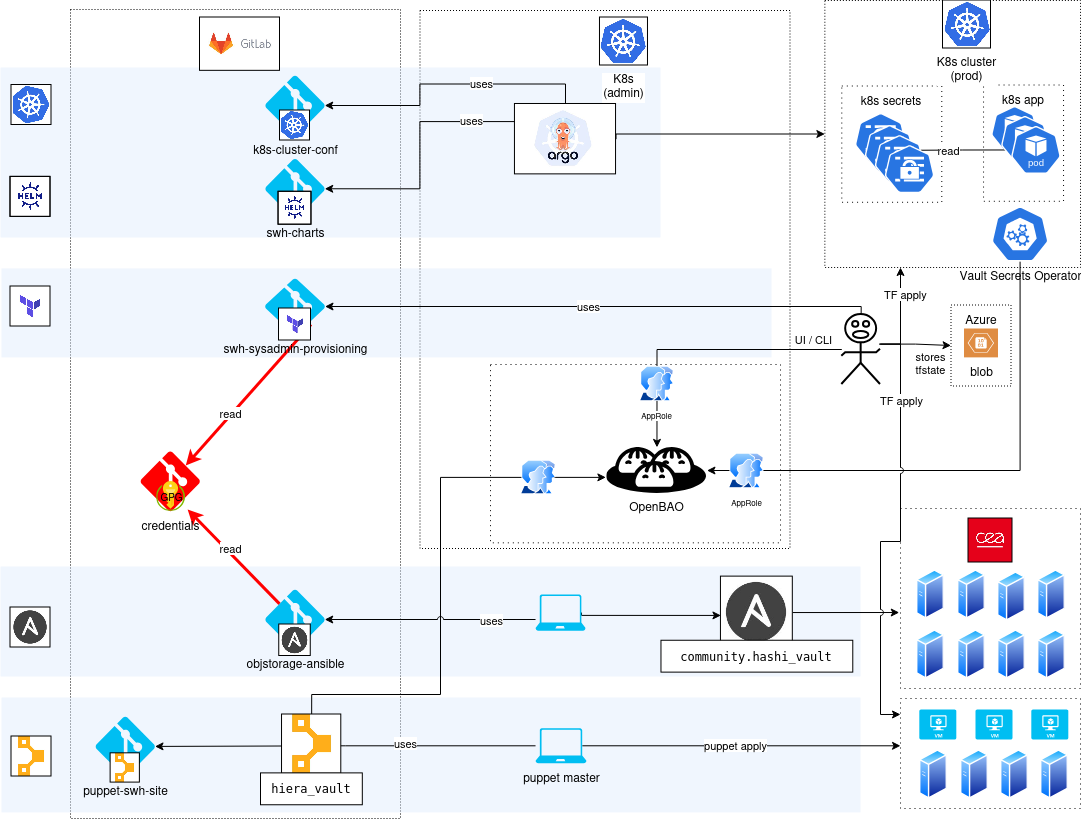
With OpenBao, secrets are:
Centralized
Encrypted at rest
Consumed on-demand (just-in-time)
OpenBao, deployed in the admin cluster, becomes the single source of truth for all infrastructure secrets.
Authentication for all automation tools, including Terraform, Puppet, and ArgoCD, is unified through the AppRole mechanism, eliminating hardcoded credentials..
Git-based credential repositories (whether GPG-encrypted or plaintext) are decommissioned in favor of OpenBao.
This approach provides:
Native encryption
Automated secret rotation
Full access audit trails
End-to-end traceability
All of this is achieved without requiring modifications to consumer applications.
5. Secret management workflow#
Creation
A human operator defines the secret in OpenBao (for example
/deposit/datasources/postgresql) and pushes its value.Declaration
ArgoCD deploys a
VaultStaticSecretresource in the target namespace (such asdepositorcnpg), indicating to the VSO which secret path must be synchronized.Synchronization
The Vault Secrets Operator (VSO) reads the
VaultStaticSecret, authenticates against OpenBao via AppRole, retrieves the secret value, and creates a native KubernetesSecret(for examplepostgresql-db-deposit) in the application namespace.Consumption
Application pods, such as
swh-depositanddb-deposit, mount or consume this secret at runtime.Maintenance
ArgoCD and the VSO continuously ensure reconciliation:
Any change in OpenBao is automatically propagated.
Any configuration drift is automatically corrected.